OzerOzer

The couple compatibility test, explained.

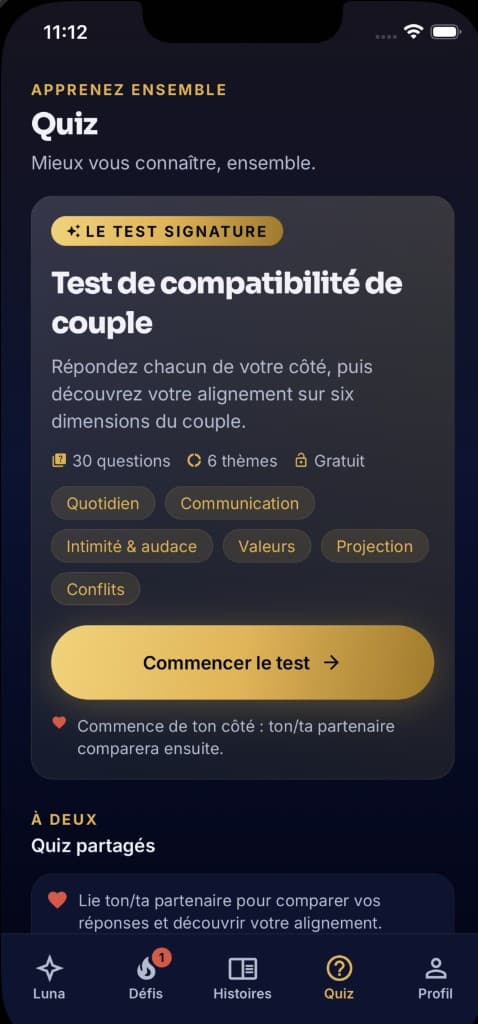
A couple compatibility test compares your answers on everyday themes to measure alignment, not to judge the relationship. In Ozer: 30 questions, 6 dimensions (daily life, communication, intimacy, values, future, conflict), separate answers in 6 to 8 minutes, score visible only when both are done. Free, no account. Answers expire after 30 days.

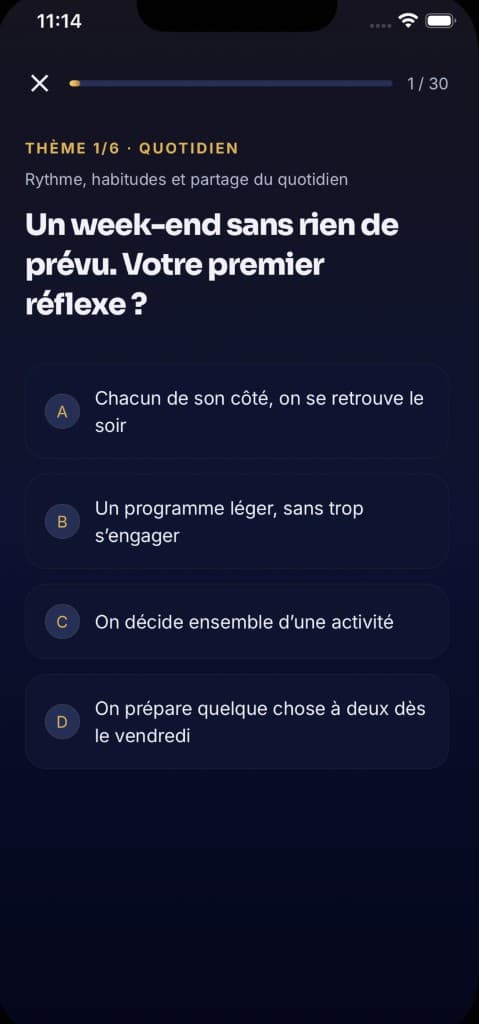
Daily life theme question in the Ozer compatibility testOzer screen: couple compatibility test, the signature test
The signature test, in the app

What a compatibility test actually measures

A good test predicts neither the length nor the “worth” of a relationship. It makes often-implicit preferences visible: daily pace, how you talk, intimacy needs, priorities, future vision, how you handle tension.

A useful result is an alignment score between two profiles, with detail by theme. It is a snapshot, not a diagnosis. A gap on one theme can be as interesting as agreement: it names a conversation to have.

Be wary of tests that promise a magic percentage or a “soulmates” verdict. Prefer a transparent method: named themes, separate answers, reading the result together.

Why answer separately

Answering together while watching each other often biases the result. People adjust, hunt for the “right” answer, avoid disagreement. Separate answers give a more honest picture of each view.

In Ozer, the score appears only once both people have finished. The reveal becomes a shared moment, not a grade one person reads alone while waiting.

How to use the result (without dramatizing it)

Start with a dimension where you feel close. Then pick one gap to explore, without deciding who is right. A difference can express two legitimate needs.

If a theme touches a sensitive spot, agree on a calm time to return to it. The test opens the door. It does not replace listening, or a professional in a real crisis.

What do the questions look like?

On daily life: “An ideal evening: cozy night in or spontaneous outing?”. On communication: “When something bothers me, do I prefer to talk right away or let it settle?”. On plans: “In five years, what must have changed for me to be happy?”.

Thirty questions of this kind, spread across six dimensions: short enough to stay light, precise enough to reveal the real gaps — the ones you never bring up spontaneously.

Retaking the test later: measuring a path, not a grade

A compatibility score is not set in stone: it photographs a moment in the relationship. Retaking the test a few months later — after an important talk, moving in together, a rough patch — shows what has moved.

That is often when the test becomes most useful: not “are we compatible?” but “where have we progressed, and which conversation deserves to come next?”. Ozer rituals (quizzes, challenges, Luna) exist precisely to keep that motion going — desire included.

Take the Ozer test in 3 steps

  1. 1

    Answer alone

    30 questions across 6 themes, about 6 to 8 minutes. Your profile shows up right away.

  2. 2

    Send the private link

    Your partner answers on their side, no account required.

  3. 3

    Read the score together

    Overall alignment + detail by dimension, without a punitive verdict.

The 6 dimensions of the Ozer test

  • Daily life

    Pace, habits, day-to-day mental load.

  • Communication

    Clarity, listening, how unspoken things get said.

  • Intimacy & daring

    Desire, tenderness, boundaries and consent.

  • Values

    Priorities, loyalty, money, family, commitments.

  • Future together

    Plans, projects, pace of commitment.

  • Conflict

    Tempo, repair, emotional safety.

Common pitfalls with a couple test

  • Treating the score as a verdict

    A score shows gaps and overlap. It does not decide your future, or the overall quality of the bond.

  • Answering to please

    If you answer “the right way”, the result becomes decorative. Honesty makes the conversation useful.

  • Turning a gap into a trial

    A profile disagreement is not proof of failure. It is often the start of a clarification.

Common questions

Prefer a test made for two, with separate answers and detail by theme. The Ozer test (30 questions, 6 dimensions) is free, no sign-up to start, and the score only appears when both are done.

Take the test now

30 questions, score for two, free, no account.